Eventfulness of form
 |
| December 2008: the cross-gabling makes an impressive bungalow frontage |
When architect Hubert Savage designed a bungalow for his own use back in 1913, he was following Arts and Crafts instincts by building it over a shallow crawl space. This move allowed him to avoid damaging the site's natural contours, instead making them into a part of the building itself. As a result, the house feels that it grows directly out of the site it stands on. His decision to minimize the depth of the crawl space also fitted the structure to the ground in a way that houses back in town - laid out in arbitrarily defined subdivisions, on typically narrower lots - normally didn't. It's true that his choice also trimmed the considerable costs of a concrete basement from his bottom line (typically, ten percent of total costs at the time; more if, in order to excavate a basement, bedrock had to be blasted out and hauled away). But Savage's choice was consequential beyond just the sparing of expenses: it allowed him, for example, on the garden side of the house, to design a building sitting more or less at ground level. In Savage's eyes that was a positive outcome, something he was clearly aiming for.
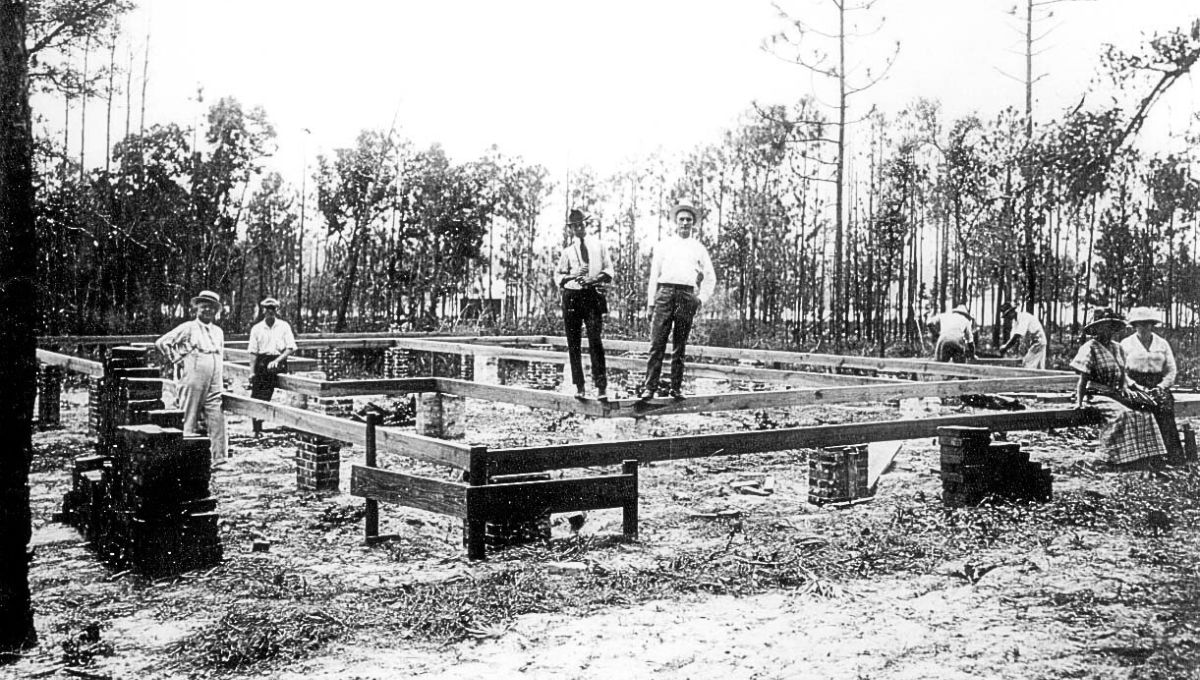 |
| Bungalow crawlspace under construction, USA somewhere, undated |
The photo above shows a bungalow crawlspace under construction (photo taken from Old Craftsman Style Homes, a social media group). It reveals how simple this method of construction was relative to excavating a basement space and pouring concrete foundations (just think of the equipment and material complexities that go into making a basement, especially on a rocky site like this). The photo above shows how brick piers were used to carry beams supporting the sills and floor joists of the house. If this all appears somewhat rudimentary now, that's because it was a technique that was rather under-developed at the time (its purpose was to simplify construction while saving money). Certainly it made for quicker and cheaper building, but this could come at the price of convenient access to the underside of the building, as well as to a more-thorough proofing against undesirable environmental factors, like insects and rodents. Note, for example, how the brick piers shown above appear to rest directly on the ground, either with only skimpy footings or with none at all. Moisture penetrating the crawlspace due to drainage issues would tend to be wicked up by the bricks sitting in direct contact with the ground - causing them, over time, to shift and spall. Savage's builders employed a similar technique in making his crawlspace: brick piers supporting sills and floor joists, coupled with curtain walls of stone to close up the perimeter of the structure. At some point, more posts were added to the underside, resting on precast cement footings, in order to better support the building in the vertical dimension.
 |
| Bungalow undergoing renovation, built on a low crawlspace, USA somewhere |
 |
| Reverend J. F. Cole's bungalow in India, on a low plinth, with liveried servants |
The shallow depth of the crawlspace certainly reinforced a horizontal aesthetic, resulting in a building sitting close to the ground in true bungalow fashion (see photo above). Traditional Indian bungalows, which the British 'borrowed' from the rural suburbs lying beyond India's teeming cities and then gradually modified, invariably came sitting on a low plinth that gave them a distinctly horizontal look. As a result, bungalows still appear most natural when sited just above the ground. And Savage obviously wanted to capture just this look for his own bungalow: a low structure, beneath a sheltering roof that was projected well out over the walls, designed in that manner to emphasize its proximity to ground. It was both fashionable, and at the same time rather exotic, to design in such a way back in 1913 - a method of differentiating the contemporary bungalow from houses that were more markedly Victorian - houses that tended to be taller (multi-storey homes with ceilings that reached as high as twelve or thirteen feet, versus eight feet and a few inches for bungalows).
 |
| 1911 ad for Garden City: note the price-creep in the subsequent ad |
 |
| Garden City backers hoped the new electric railway would trigger growth |
But whatever led the Savages to build their house way out in what was then still part of the boonies? Certainly it didn't hurt that quarter acre lots were advertised as coming with city water and electric lights, as well as the promise of sidewalks and graded streets (see first ad, above, but note that these claims have disappeared in the 1912 version). The real answer to this question undoubtedly had to do with the cheapness of quarter-acre parcels in Garden City, a suburban enclave of mostly cleared land with a smattering of choice upland parcels (like the holdings the Savages would acquire). The investors backing this real estate development play hoped that Garden City would build out rapidly, courtesy of a new electric railway (see the ads above, which depict an electric Interurban railway line that was to open in summer 1913). The Savages' land purchase allowed them to build a new home within walking distance of a stop along that line. A location within a walkable distance of Marigold Junction made commuting downtown, where Savage's office was located, feasible. And it also meant that the Savages got to inhabit a ridge-site dotted with mature oaks, at a comparatively short distance from downtown (three miles, or roughly five kilometres). The opportunity cost of their purchase was unbelievably cheap relative to today's inflated land prices - if we assume the Savages bought two premium upland parcels, which they could have done for no more than $1200 (ultimately, sufficient land for subdivision into three generous parcels, with a leftover piece added into Marigold Park). Their cost of purchase, rendered in 2024 dollars, would have been just under $38,000 (if they paid full price based on the ads). Now that a single, featured RS-6 nearby lot sells for $800,000 (in 2023) their purchase price represented a considerable bargain.
 |
| Garden City Hall, built in expectation of rapid development, circa 1921 |
As a credentialed British architect with Arts and Crafts sensibilities, Savage was determined that his new bungalow do minimal damage to the natural landscape (he knew how rare the opportunity before him really was). This was in sharp contrast to the way things happened back in town, where the natural context wasn't often permitted to suggest the orientation or design of a new house (except, that is, for upper-end parcels). The principal facts for consideration in town were adjacent houses sitting on streets of uniformly platted lots. But out in pristine countryside, in the newly minted Municipality of Saanich, on a large lot with abundant features, nature could be allowed to play a more formative, even a defining, role. Working in concert with the immediate scenery, rather than disregarding it in favour of houses packed onto long thin lots like tinned sardines, gave Savage an opportunity to design a structure that was compatible with its surroundings, making for a more picturesque outcome. Savage's interest in building unobtrusively in the landscape, and turning existing scenery and natural contours into context for his new building, just happened to align with the natural hollow that paralleled the ridge on which the bungalow was built. This physical feature, coupled with Savage's preference for benign methods of construction, led him to utilize the natural hollow as his crawl space.
 |
| Modern building site: cleared and levelled, emphasis on convenience for contractors |
Following the design-lead offered by the natural hollow also enabled him to orient the building optimally to capture light and views. All Savage had to do, given the physical structure of the site, was limit the length of his building to the hollow's extent. Given that he was aiming to design a small, artistic bungalow anyway (a structure of less than 1600 square feet, all on one floor) this limitation on length did not involve major sacrifice. Of course, there was a significant outcome from siting a building this organically, which is its remarkable proximity to ground along the western and northern edges. But as we will see, there were also other advantages that flowed from this method of orienting the building.
 |
| Small crawlspace door, inhibiting straightforward access |
While the shallowness of the crawlspace was arguably aesthetically desirable for the look of the bungalow, Savage's choice of location for the access turned getting under the building into a chore (see photo above, noting how small the crawlspace door actually is). Placing it in a cramped location between the building and rising bedrock, and right up against one of the supporting brick piers (to the right, photo above) necessarily complicates the acts of entering and exiting. Some bungalows on crawlspaces dealt with this problem by providing an access from within (using a panel in the floor that could be lifted, which might be placed in a corridor or even in a substantial closet). Savage however, for reasons that remain unclear, preferred exterior entry, yet shied away from locating the door where the stone foundation was deepest and the access to the crawlspace could have been larger, which would have simplified getting under the building. Clearly, Savage the architect was keen to minimize the size of the access, which he succeeded brilliantly in doing. As a result, the opening is scarcely big enough for a full-sized adult to get through. Worse still, because the door is located where bedrock rises towards the sill plate, one has to enter the crawlspace feet first, on one's stomach, in order to be able to properly orient inside (the crawlspace floor deepens quickly once you are fully in, but as the ground falls away sharply, backing-in is a necessity. As well, these problems have been further complicated by the more-recent addition of a cast-iron sewer pipe, which further constrains the entrance. It's almost as if Savage felt he wouldn't have to ever go down there himself! But of course, one does have to get under the building to access the plumbing and electrical systems. I cursed that small, awkward entry point (door-less when I first moved in) through three-and-a-half decades of otherwise comfortable living there, because it turned getting under the building into a chore. And not least in an emergency situation, such as when, in the dead of winter, in the middle of the night, a pipe under the building bursts due to cold weather, and then has to be turned off manually - something that actually happened during my first winter there. I subsequently had the plumbing system reconfigured so there were shut-offs within easy reach of the crawlspace door, in case something bad ever happened at night again.
Accessible Remoteness
Alan Gowans, who penned The Comfortable House: North American Suburban Architecture, 1890 - 1930, notes that houses designed expressly for greater human comfort first arose in the new middle-class suburbs made possible by reliable forms of long distance transit (at first, by steam railroads in America). Later, electric streetcar networks were built in cities across North America, then were followed by longer-distance electric Interurban rail lines that linked regionally dispersed centres into new networks. Streetcar and railway networks began distributing residential enclaves as exclusive suburbs on the periphery of urban regions across North America. In addition to homes now incorporating novel arrangements to enhance creature comforts (like electric wiring, telephones, indoor plumbing, bathrooms, hot water, and central heating, all of which arrived in what seems the blink of an eye) Gowans argues that these rural enclaves also sponsored an entirely new form of dwelling - one designed expressly for more-rural locales, with more-generous natural landscapes than was standard for lots in the city. In the instance of the Grange Road bungalow, we can see an example of this new dwelling-type emerging, built well out in pristine countryside, with access to its relative remoteness enabled by a novel form of electric rail transit.
 |
| Tod Inlet station, a stop along the Saanich Interurban Line, ca 1919 |
 |
| Scale model, interior of an Interurban Line car, courtesy Aaron Lypkie |
 |
| Downtown Interurban platform, across the road from Victoria City Hall |
"The
idea of a location far enough from the city to have rural qualities –
open fields nearby, good-sized garden behind, and set off from the
street by a front lawn – yet close enough for people to commute to
the city to earn their living, was new." The rural lands opened to development by rail access lies behind the novel house-type, a hybrid form that Gowans calls "a combination of country and city home," one with "a basically horizontal look...with the long facade facing the street". In this sense, Savage's picturesque intentions for his own bungalow just happened to mirror what was happening in rural suburbs across North America. But being an architect designing a home for his own family's use, he could endow his version of the bungalow with bona fide Arts and Crafts attributes (for example, organic building placement, see first section above).
 |
| Artistic bungalow, gable-end facing the road, in Victoria (now stuccoed) |
 |
| Savage bungalow, length turned towards Grange Road, rural suburb-style |
Not only did the length of the new house-type face the road (in what would become typical of suburban layouts) but this novel form of placement stood in sharp contrast to similar buildings found in town, which were increasingly being built with their main gable ends facing the road, to accommodate their more standardized, narrower lots (see the top photo above). Having the length of the building turned towards the road back in 1913 constituted a novel look in domestic architecture, one that derived ultimately from the relative cheapness of the rural lands that were now conveniently connected by rail to the urban core. "Neither city nor country houses, they represented a really new kind of dwelling, designed for a new, suburban kind of place." I would contend that this is precisely the sort of dwelling Savage imagined out in the back of beyond in Garden City: an Arts and Crafts bungalow with all the modern conveniences of the day, a building on a single level with a sheltering roof form and emphatically horizontal lines, its long cross-gabled facade facing the road, perched remarkably comfortably in a minimally altered natural landscape.
 |
| The cover of Garden Cities Of Tomorrow (1901) |
The Garden City idea, as elaborated by Ebenezer Howard in his Garden Cities of Tomorrow (1901) didn't quite fit the local vision for Saanich's Garden City, which might more accurately have been called a 'garden suburb' rather than a city. It was envisaged as a place of residence primarily, and in no sense was it ever intended to foster a complete community with industries and farms as part of its makeup (Howard's actual vision for Garden Cities). The people who lived in Saanich's Garden City were expected to commute daily to downtown in order to earn their living, retreating at night to their residential enclave. Which is precisely how the Savages used their new dwelling.
 | |||
| Government St. back in the day: note gable ends facing the road | |
 |
| Vancouver, West End, houses with gables facing the road, on narrow lots |
The differentiation of suburban-style buildings located in open countryside from their in-town counterparts was often further accentuated, Gowans says, by the practice of designing markedly different facades for the front, sides, and rear of the house - an approach that further individualized the building, adding considerably to its visual appeal (usually these houses also came with enhanced linking environments, such as paths, verandahs and sleeping porches). Houses in town, built on narrower, more standardized lots, tended towards sidewalls that looked similar, with fewer windows due to the proximity of the neighbours. The Savage bungalow differs in every way from houses with sidewalls designed alike, but here the process of differentiating facades was taken a step further, Savage ultimately creating a house with four unique facades. Of course, back when the Savages built their bungalow, there were no other neighbouring dwellings standing nearby - all of that was still to come, but certainly they expected it to happen, because the people moving to Garden City believed that the new rail link would trigger rapid growth (as did the entrepreneurs who invested so handsomely in building the Interurban line). That's not the way things played out ultimately, however: the new rail line came to be so starved of customers that by 1923 the BCERC had to shut it down, a victim both of the profound economic slump that began in late 1913 combined with the declining ridership in the First World War-era, and unregulated competition from the jitney buses that suddenly appeared in droves (see picture two below). Over 150 such jitneys were active in the Victoria region alone (they were strong enough to form an association to lobby against government regulation) which cut dramatically into the electric railway's passenger business. But ultimately the new reality may not have mattered too much to the Savages, who got to enjoy a luxurious scenic hillside and design a unique bungalow to live in.
 |
| Opening day in 1913, Saanich Interurban line, Sluggett family photo |
 |
| Lake Hill 'jitney' bus in the 1916 snowstorm: unregulated competition |
 |
| Cross-gabled east-facing front facade, emphasis on the horizontal line |
Four Facades Uniquely Designed
As an architect, Hubert Savage had opted to run his bungalow along the ridge defining the site (from south-to-north) which, among other things, allowed him to impart a feeling of grandeur to the building from the approach path (the plain quality of the main gable roof form is here relieved by a trio of cross-gables that step the building dramatically out into the surrounding landscape). The house (photo above) is evidently designed to emphasize its horizontal lines and proximity to ground, thus standing in marked contrast to the more vertical, Victorian-era buildings that were typical of homes in town (see next photo).
 |
| Bungalow beside a Victorian-era house: horizontal vs vertical emphasis |
Savage took advantage of his upland site to generate long front and rear facades for his bungalow. Fitting the house intimately to the site, he contrived a shallow oblong - only two compact rooms and a small circulation corridor wide for the rear (or northern) half of the building, deepening somewhat at the south end to accommodate a rear porch with a garden door (which also served as a 'summer tea room'). This addition to width is achieved by jogging the footprint outwards and a slight lift of the roof-line. The cross-gabled frontage is consistent with traditional Tudor-era buildings from Savage's native England, an attribute he transformed masterfully into two roofed bays book-ending a welcoming verandah (see second photo below). This verandah, with its substantial roof resting comfortably on tall tapered stone pillars crowned with trios of short, chunky timber posts, impressively dresses the ridge site.
 |
| Fords Hospital, Coventry, England, built in 1509, cross-gabled roof form |
 |
| Cross-gabled roof, dramatically advancing verandah flanked by twin bays |
The bungalow's south wall (its actual gable end) differs totally from the street facade in its treatment, comprising an asymmetric assemblage of window shapes, types, sizes and formats that are integrated into a consistent whole (as shown below: balanced overall, window placement dictated by the floor plan). On this wall Savage delivers a facade that displays what author Nicholaus Pevsner once characterized as the English genius for "informal grouping" (see The Englishness Of English Art).
 |
| South facade: an asymmetrical collage of shapes set into a horizontal matrix |
 |
| South wall pictured in more wan end-of-day light, in December 2017 |
Along this wall, a pair of projecting bays sport unusual fixed-pane leaded-glass windows, one (to the left, photo above) a transom above leaded-glass casements, the other a standalone window composed of hexagonal panes. Untypically for this house, the roofed bays on the south wall also show exposed rafter tails - a touch of Craftsman-type styling - whereas the main soffits are all enclosed, covering the rafters in a manner consistent with local Arts and Crafts styling. Overall, the south wall impresses the viewer as dramatically as the street facade, while exhibiting entirely different features (yet continuing Savage's pattern of jogging of exterior wall planes to achieve a lively movement). Due to the way the land falls away in the south-east, necessitating a much-deeper stone foundation there, the south facade seems dramatically taller than the north-facing gable end (photo below) where the building appears to rest directly on the ground, without visible foundation, and is clearly just one storey high.
 |
| The west wall differs dramatically from those facing east and south |
 |
| The west wall roof lifts slightly to accommodate the back door and porch |
 |
| Porch roof lifted slightly in order to accommodate the array of functions |
The long west wall steps outwards at the southern end (to the right, middle photo above) with the roof lifted slightly to accommodate the rear porch and a garden door (and which, on our watch, became a conservatory room with a window seat). You can make out the slightly lifted roof in the photo immediately above, enabling just enough height-gain for the back porch and utility hub. Note also how, on this facade especially (middle picture above) the bungalow sits remarkably close to the ground, literally resting on it along the north wall (to the left, top picture above). This facade has its own visual appeal, but here the architect reveals the main gable roof with its two chimneys. Here too the bungalow declares that it is just a storey high (photos below). In contrast, the main gable roof is largely masked from view on the front facade, due to the land's elevation and the prominence of the cross-gables. But on the west side, one steps out through a back door that feels remarkably close to ground, then walks out into a protected garden set in an oak meadow.
 |
| Front facade with prominent cross-gables masking the main roof form |
 |
| The west wall sitting at ground level, leading out into the oak meadow |
The photo below shows the north facade of the house, which architecturally resembles the south end, but with far less of the drama attributable to height and unique detailing. Few windows appear on this facade, by design (I believe Savage knew that one day another house would most likely be built to the north). At the north end, the natural hollow beneath the bungalow is very shallow, making this part of the crawlspace difficult to access. This fact does however reinforce the bungalow's remarkable proximity to ground, making it feel fused with it. At some point early on, Savage decided to add a walk-in closet beyond the bedrooms situated at the north end. This addition explains the small shed-roofed structure nestled against the gable-end (photo below) - which Savage turned to account as a way to further differentiate this facade. You can also see that Savage designed the walk-in closet to reflect the site's natural contours, preferring to step the bungalow up the land-form rather than excavate the rocky outcrop (the modern building culture's instinctive choice would have been to level the outcrop). This was made to benefit the interior too, by creating a second level for the building footprint that entailed a substantial step-up for access. The walk-in closet is shown as existing by the time Savage annotated the first version of the floor plan in 1933 (so the work was done prior to that date). The walk-in closet made a seamless addition to an already complex smaller building. Heritage consultant Stuart Stark remarked that the walk-in closet, from the outside, possesses vaguely art-deco features, making for a slight design-discontinuity with the main building, but done so that it's still congruent with the bungalow's overall design. Perhaps this was a way of demonstrating that buildings do in fact grow over time, and that he was not afraid to demarcate a new building era?
 | ||||
| North gable rising from ground, walk-in closet stepped up the landform | |
 |
| Step-up to the walk-in closet means an added level |
Books For Looks:
Alan Gowans, The Comfortable House: North American Suburban Architecture, 1890 to 1930, 1986.
Nicholaus Pevsner, The Englishness of English Art, 1956.
Ebeneezer Howard, Garden Cities Of Tomorrow, 1901.

This piece is a beautifully written deep dive into both architectural philosophy and historical context . It captures Hubert Savage’s Arts and Crafts vision with impressive clarity—his sensitivity to landscape, respect for natural contours, and preference for harmony over dominance come through strongly. The explanation of crawlspace design versus full basements is informative and well-linked to both economic and aesthetic motivations. The inclusion of period ads, contextual comparisons to Victorian homes, and reflections on early suburban development in Garden City add rich historical texture. The writing feels scholarly yet approachable, blending technical insight with narrative storytelling. It’s an elegant exploration of how architectural form, site, and philosophy intersect to create a sense of place—a wonderful read for anyone interested in early 20th-century design thinking and its enduring influence.
ReplyDelete